 2.
Sailing
to Byzantium
2.
Sailing
to Byzantium2.
Sailing
to Byzantium
I
guess you might wonder about the wisdom of my going to Turkey with a
broken leg
and my suitcases full of drugs. When I left New Zealand in February
2004 I did
not have a broken leg. I was using crutches and I had braces on both
legs to
counter foot-drop, which is what happens when the nerves in your feet
and
ankles die – your feet don’t lift when your legs do
and you trip over your own
toes. But that wasn’t what had broken my leg this time.
As
for the suitcases full of drugs –
they weren’t illegal – except the codeine, which I
hadn’t been able to bring
myself to dispose of in Italy, especially after smashing myself up in
the men’s
shower in the Villa Camerata in Florence. The trouble with foot-braces
and
elbow crutches, is that there are times when it is impractical to make
use of
them. Showers are one such time, toilets are another. I’d
left the crutches in
my room and gone barefoot to the ground floor bathroom. The
women’s shower room
was on the floor above and I didn’t want to use the stairs,
so I quietly took
the shower at the far end of the men’s cubicles, dried and
dressed inside the
shower box, and sneaked forth – just as some ugly person
turned the lights off.
I yelled out of course – there were limits to my want of
invisibility – but the
lights did not come back on.
The
thing about having no feeling in your feet is that you
cannot sense any
irregularity in what you are standing on. So you find yourself falling
without
ever having the chance to correct your balance. Normally, feet are
terribly
clever. When I think about how I used to get around in high-heeled
slip-ons
(slip-offs), I am just so impressed about how clever the feet of women
are. I
suppose that some clever-dick will respond that women keep their brains
in
their shoes. My answer, if I were to answer, would probably be that at
least,
that way, they keep them out of the shit.
Anyway,
I looked the next day and
found I’d stood on a row of tiles sloping into a drain. My
left foot had
slipped violently and knocked my right leg out from under me, thus
causing me
to thump down hard on my left side. I picked myself up – as
you do – with a
powerful sense of injury and indignation. My ankle felt bad and I was
hoping
like hell that it wasn’t too badly bruised. It felt broken,
but I’ve had broken
ankles before and discovered, to my cost, that treating them with a
plaster
cast can be worse than ignoring them. If the plaster starts breaking
the skin
you can get cellulitis and that telltale red line tracking up your leg
in no
time. Then again I’ve had a bruised (but apparently unbroken)
ankle that was
more painful than the broken one. I didn’t know what to hope
for.
The
next day I knew that things
weren’t so good when I was suddenly obliged to get out an
airsick bag and vomit
into it at the breakfast table. I studiously avoided looking at the
other
people at the table, so I don’t know how they responded. I
decided it was time
to shoot some intra-muscular hydrocortisone before I lost it
altogether. I managed
to walk, with Finn, down the long driveway from the Villa Camerata,
through
spring-green woods, to the bus stop. But I had to change my crutch
technique
from the sort of cross-country skiing way, to the one-legged hop with
both
crutches together. It was very tiring – especially to the
shoulders and neck.
I
was eager to get to the Uffizi early, as we had to wait in
the great
Unbooked queue, but Finn kept being distracted by this and that, and by
the
time we got to the gallery there was a queue around three sides of the
square.
I bit the bullet and positioned myself at the rapidly growing end of
it, but
Finn baulked. There was no way he was gonna wait half a day shuffling
round in
a queue. He would cross the Ponte Vecchio and take a walk up the
hillside. He’d
come back in a few hours.
So
I dragged my rapidly swelling
ankle round the square for nearly four hours. Behind me there was a
group of a
dozen or so young Italians who took the happy attitude that queuing was
as much
fun as viewing. In four hours you can grow quite fond of people without
even
exchanging a word. I took photos of them and they performed for the
camera. As
we edged up towards the door, Finn came back and brought me some food,
which
was good. I have a high pain threshold, but the leg was powerfully
painful, and
I was knocking back the codeine and doing panadol to the liver-safe
max.
When
I think back now, I can date an
emerging bad temper to that day. Just as
we got to the place where the queue to the gallery goes behind a
barrier, I
watched two young and very beautiful Italians – they could
have been brother
and sister, with the same long dark wavy hair and the same petit
exquisite
features – nonchalantly approach and sidle into the queue
behind me, and take
up residence there as if they’d been there all day.
“Actually,”
I said loudly, “the end
of the queue is over there.” I pointed across to the other
side of the square.
“Oh,”
said one of them in
beautifully accented, but flawless English, “we thought this
was the end.” They
looked studiously innocent.
“Oh
yeah,” I said, “Try pulling the
other one. These people and I have waited here for hours,
so bugger off!”
“Oh,
we didn’t know,” they
protested. They clearly thought that I must eventually be swayed by
their
beauty and innocence.
“Bugger
Off!” I said, pointing a witch’s finger
at the end of the queue across the
square.
I
swear it was the leg talking.
That
night, after four hours in the queue and four hours in the gallery, I
was
shocked to see that both the ankle and the knee were blackened with
bruises and
the whole leg was swollen. I still thought it was the ankle that had
come off
worst, but the knee was increasingly painful. Even so, I was hoping it
was just
a matter of toughing it out for a while until it healed.
The
next day we went to Ravenna.
Battling bags and buses
left us both buggered before we even got to the station. But changing
trains at
Bologna became a bit of a nightmare until we found a helpful official
who got a
free porter to take our bags on a funny wooden cart to the locked lift,
conduct
us down a long subterranean corridor and up another locked lift to
platform 11.
Ravenna is
wonderful. It was, for a while,
the capital of the Western Roman Empire. Long before that, in 49 BC, it
had
been the place from which Caesar went to cross the Rubicond –
though I’ve never
been quite able to keep in my mind the reason why Caesar felt obliged
to cross
the Rubicond. I was inspired to walk considerable distances in Ravenna,
but
keeping expenses down went to hell when we tried to find a bus to Saint
Apollinare in Classe. My leg insisted on taking a taxi to see the
sheep. And we
took a taxi back to the hostel.
Had
I known what was to happen when
we got to Bari, I would have extended my stay in Ravenna and spent more
time
with the mosaic apostle-sheep in Classe, or with the Good Shepherd and
the
sheep in the exquisite little cross-shaped church called the Mausoleum
of Galla
Placidia, though it maybe isn’t, since Augusta Galla Placidia
– daughter of
Theodosio the Great, niece of the Emperor of the East, mother of the
Emperor of
the West, and a ruler in her own right, even if she were a woman much
handed
around in marriage and incest at the hands of her brother, from whom
she
escaped by sailing to Byzantium and returning in triumph –
actually died, in
450, in Rome. But the idea that she might have chosen to spend eternity
under
the magical starry sky in the little dome is irresistible. I felt none
of the
claustrophobic horrors, there, that tombs more often trouble me with.
The
drinking doves and the deer and the sheep and all the fruits and vines
are so
reassuring. And the stars!
I
might even have spent more time
with that illustrious couple who seem to epitomize Byzantium,
Justinian and Theodora, who never came
to Ravenna, but
sent their armies to conquer the Arians, and their images in tiny
pieces of
glass all the way from the Golden Horn.
But
I’d forgotten my password for
Paradise email, so I missed all the messages from Paleologos Superfast
Ferries
telling me that the ferry we were booked on would not be sailing
because it was
Easter Sunday. I found myself taking a dim view of Bari even before I
got to
the ferry wharf. At the train station there was a line of taxis, but
the
officious men insisted I go to the one at the head of the queue. This
involved
walking a lot further, so I made a little scene and pointed out that I
was
getting a taxi because I wasn’t fit to walk. Then, as I
started hobbling
towards the other end of the line, they decided that I could take a
taxi at
this end after all.
The
driver spoke no English and made
me think of a blue-eyed killer. He had no clear idea of where the
Superfast
Ferries left from, so he took us on a roundabout route, dropped us at
the wrong
place, and insisted we pay him more than twice as much as even the
roundabout
way should have cost. By the time we had dragged my livid whale of a
leg and
the bags to the right wharf I was already very pissed off, but when we
were told
there was no sailing I lost it completely and sat down on the bags and
sobbed
while some Italian jokers, vacillating between concern and amusement,
kept
optimistically insisting that there was “No problem,
Lady.” I
didn’t know what planet they were on, but
the one I was on was rapidly degenerating into utter dysfunctionality.
Bari
might have stolen the relics of Santa Claus from Turkey, but St
Nick’s
corporeal remains had obviously not done the town any lasting good.
Eventually
we got to Greece. Day hadn’t broken in Igoumenitsa. A taxi
took us to the
correct bus station without overcharging. But the bus station was not
built to
accommodate buses. They had to resort to backing and bother just to get
through, so I found myself sitting there in the pre-dawn dark wondering
how the
descendants of the people who had built the Parthenon could not even
build a
workable bus station. They could make good roads, though, across
mountains huge
and icy in the spring dawn, with Judas trees blooming a violent pink
among the
green trees, and white blossom trees clinging to bare hillsides in a
thick low
cloud.
At
Ioannina we had time to walk
around the lakeside below the cliffs of the Kastro. There were rowers
out
training on the lake and, near the point, two men – obviously
full of the joys
of spring – were singing their heads off. In a wide strip of
lawn dotted with
large sculptures, I lay down in the sunshine on grass thick with white
daisies.
It was only later that I discovered that the 35 Euros in notes that I
had stuffed
in the coin-pocket of my bum bag had fallen out because I had neglected
to
close the zip. Finn ran back to the spot but only recovered 10 Euros
and a few
coins. It was an indication of how tired and pain-affected I was. We
were
already too far over budget to be literally throwing money away.
Finn
was already irritable about the
slow pace I was making him keep, and he hated the pain that showed on
my face.
He couldn’t help interpreting it as anger or disapproval, and
he took it
personally. Now he became positively angry with me for losing the money
and for
his failure to find it.
Things
came to a head when we lost
our way back to the bus station. Finn didn’t really care
about how far we had
to walk, so long as he could find his way without asking for help. I
was pretty
exhausted and my arms and shoulders and neck were aching along with the
dire
pain in my leg. As I made a move to approach a young man to ask for
directions,
Finn humphed with disapproval, so I
turned on him and accused him of being “a heartless
arsehole” who didn’t give a
shit about making me walk further than I needed to.
“And
do you absolutely have to be the
typically pigheaded
bloody Kiwi male who can’t bear to display what he
can’t help seeing as his own
inadequacy due to not having a fully functional Global Positioning
System
implanted in his scrotum before birth,” I screeched
recklessly. “And why the
fuck does it matter so much to you, if some young Greek guy
you’ll never see
again in your entire life, thinks that you are somehow inadequate
because you
don’t know the way back though streets you’ve never
seen before, to a bus
station for which you have no map? Why the hell do you damned silly men
have to
pretend that you fell to earth in a space-egg when every mother knows
you’re
just little sucky babies who come out bigger, and take longer to grow
up, and
keep killing yourselves when you get it wrong?”
Naturally,
this outburst was not
calculated to bring about the immediate cessation of hostilities, but I
was
already feeling that freedom of the desperate. That humph
had been one humph
too many to humph onto a camel with
a
very sore leg and no sleep on an all-night ferry which had vibrated
heavily at
exactly the same frequency as the quake of a diabetic having a bad
hypo. It was
the last straw and I just had to get the whole lot off my chest
– or my
evil-tempered camel’s back.
I
found the bus station – by asking
– and Finn sulked. He retrieved the bags from short-term
storage, and I sat
down on them and asked him to ask the bus drivers which bus was heading
for
Trikala and stopping at Kalambaka. He disappeared and didn’t
come back. I got
more and more angry and went, myself, to get the information
– an almost
pathetically simple task. Then he turned up saying he hadn’t
been able to make
himself noticed. He’d tried to be polite and wordy, and all
they’d wanted was
loud and simple: Trikala bus? Yes
this bus Trikala. Kalambaka
stop? Yes, yes Kalambaka stop.
Luggage?
I
was feeling sorry for my boy now.
Being blunt only comes naturally to him when he’s angry, and
asking strangers
for information produces fear in him but not anger. He has to get over
this
before he can ever make his way in life, and I am really the only
person on
hand who cares whether or not he makes his way to anywhere at all. But
he was
still mad as hell. Instead of helping me onto the bus, he got in first
without
even taking my carry-on bag. I struggled up the steps with some urgency
because
I could see that a woman with a small child felt impelled to assist me.
I saved
her the trouble. I saw no place to put my small, but heavy backpack, so
I
dumped it on Finn without remorse, and squeezed myself into the seat.
My leg
could still bend at this point.
Finn,
who normally hates sulky
behaviour, sulked all the way to Meteora,
but the sight of that
fantastic wall of rocks (though rocks
hardly begins to describe those massive, mountainous upthrusts) made
him forget
all about the heaviness of his pride and my baggage. I had chosen the
Hotel
Meteora from the list in my guidebook, but I began to think it was a
mistake
when I saw that it was at the top of a steep slope. Finn, however,
surged up
the hill bearing his backpack and dragging both my heavy trolley bags
topped
with both our day packs. The hotel manager saw him coming and raced out
to
relieve him of some of the bags, but then he saw me hefting myself
painfully up
on my crutches, so he jumped in his car and came down to get me. Later
we went
out for a very good Greek meal where Finn discovered the delight of
moussaka,
and he dragged me back up the hill, impressed by the stars and the
soaring
darkness of the rocks. We could see some little lights and a cross on
the tops.
Finn ached to get up there.
In
the morning, after a breakfast
during which I fell under the intense scrutiny of the
manager’s noble Mama, we
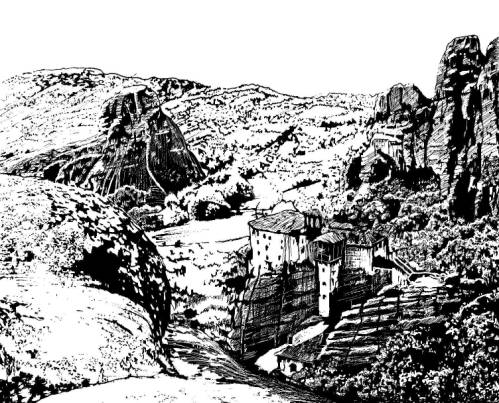
took the bus to Kastraki and set off up a path made very sweet by the
blossoms
of lilac and hawthorn and plum and snowball trees and countless other
flowers,
along with the perpetually miraculous and unsynthesizable green of
spring
leaves. Who would ever wish to forego winter and lose such a reward for
enduring it? Even my leg was lightened by it.
I
had some doubt that we were going
the right way, but Finn was unstoppable, and I figured that this was as
good a
way of seeing the place as any.
It was a gorgeous day
(we got sunburnt) with just a bit of wind in exposed places. The track
got more
and more like a goat track, but there was a stream alongside it and
lots of
fragrant herbs like pennyroyal, which released its delicious smell
under our
feet. We saw hardly anyone. Everyone else was going up the regular road
in cars
and tourist buses.
Just
where our path crossed the regular road, a shepherdess emerged from
under a big
hat. We heard her flock of tinkling goats and sheep, guarded by two big
black
dogs, before we saw them. Finn decided to take the mountain path up to
the
monastery (even though I assured him the road would take us there) so I
waited,
on a seat under some trees, for him to go up and back down as well. As
he was
leaving, the shepherdess brought her flock out onto the road and down
the path
we had come up. He took the camera with him so I was unable to record
the scene
that followed.
Having
heard the tinkling of the sheep and goat bells begin to fade, I was
interested
to find it increasing in volume again.
Suddenly a very flustered shepherdess reappeared with her
flock and
disappeared behind a huge round boulder the size of the Albert Hall.
There was
a lot of swearing (I presume) in Greek, and what sounded like a bit of
flogging
as well, and then they all appeared again and there was a bit of a
contretemps
between the flock and several motorists who seemed unacquainted with
the nature
of such beasts, and one naughty billy (perhaps the subject of the
probable
swearing and flogging) ran off the wrong way − up the road
instead of down the
track − and I was reminded of just how quickly Arcadia can turn into something else.
I
waited an awfully long time and saw almost no one except an old Greek
couple
who were terribly well dressed and well-educated people. They had a
conversation with me and with each other. I gather they were debating
about
whether to offer me a lift up the hill by the regular road. They may
have been
disturbed by my pallor. The man had looked at my diary and knew English
when he
saw it, and he asked me if I was all right. It took me a while to
convince him
that I was perfectly all right and that I was just waiting for my very
adventurous son to stop thinking he was a mountain goat. Then a dog
came to
visit me, and an English couple emerged from the path and assured me it
was a
very long way. Another old Greek woman appeared with a bunch of
wildflowers,
and she sat by the road for a while. Finally Finn appeared looking
elated. We
smiled and spoke to the old Greek woman as we set off up the regular
road.
 But
it was getting quite hot, and it was steep, so I stuck out my thumb
experimentally, and we looked round as a car stopped, and Finn said
"It's
a taxi" and we laughed and then laughed some more when we found the old
Greek woman sitting in the back with her mobile phone, and she was
arguing with
the old Greek man who was driving and they gave us a ride to the top of
the
hill and the old man laughed and waved away my offer of money. He got
another fare
and tooted at us on his way back down.
But
it was getting quite hot, and it was steep, so I stuck out my thumb
experimentally, and we looked round as a car stopped, and Finn said
"It's
a taxi" and we laughed and then laughed some more when we found the old
Greek woman sitting in the back with her mobile phone, and she was
arguing with
the old Greek man who was driving and they gave us a ride to the top of
the
hill and the old man laughed and waved away my offer of money. He got
another fare
and tooted at us on his way back down.
We
had noticed that Greek men and women do a huge amount of arguing. It is
usually
the women sounding off at the men, who are classic avoiders and
don’t really
argue back (very annoying that − the men get to remain the
"good
natured" ones, and the women never manage to get the bastards sorted).
The
men bugger off to the teashops, and the women take out their
frustrations on
the billygoats.
Finn’s
email home that day made it sound as if I was too lazy to go up the
steps to
the monasteries, which capped the vertical mountains of stone. I would
have
been fine about climbing up the
steps
to the damned monasteries, it was climbing down
again that I couldn't face. It would have been painful, yes, but
dangerous
also. Even Finn confessed that he thought the wind might blow him off
the steps
in parts. The fact is: I walked along that road between monasteries for
bloody
miles and bloody miles, and right near the end I broke down and cried
by one of
those roadside shrines. And I was rescued (Finn too, he had sore feet
that
night) by a traveling van full of Romanian Christians who were on their
way to Athens
to an “Aloe Vera Gelly Conference”. There was an
economist woman who could
speak English and decided that it had
to happen that we met on the road like that, and she was sure that
their aloe
vera "Forever Living" product would cure me. They also had a doctor
with them who felt how hot my leg was and prescribed an X-ray. They
took us all
the way back to Kalambaka, and they scared Finn with the two young
women in
their company − at least Finn said afterwards that they were
"intimidatingly hot". Yes, very slim and small, but they seem to have
used aloe vera on their breasts to achieve miracles. Or maybe their God
does
have a sense of humour.
Anyway, it was a great day, right to
the end when the van had to stop for a stroppy billygoat that had gone
to sleep
in the middle of the road.
At
breakfast on the morning of our departure from
Kalambaka, the reason for Mama’s scrutiny of me became clear.
This thin,
black-dressed, perfectly grey-coiffed woman who seemed to be very much
in
command of the sons and the rest of the family, had seen that I did
blood-tests
and injected insulin, and concluded that I was diabetic.
She had become a Type
II diabetic (usually non-insulin-dependent, usually late-onset). She
had no
blood-sugar monitor, and was a little concerned about her BG levels, so
she
sent the son to ask if I would use my equipment to test her.
I
was a little appalled at how
trusting she was. I didn’t have a clean lancet except in the
bowels of my carefully
packed suitcase. The lancets in my finger-prickers get used for months
before I
decide they are a bit blunt and change them. If I lose one when
I’m out
somewhere, I just prick my finger with an insulin syringe. So I found
an unused
syringe and she meekly gave me her hand. I pierced one of the
fingertips,
squeezed, and touched the fat ladybird of blood with the test-strip of
the
meter my now-ex-friend, Jade,
had given me after I’d lost my Glucocard in the Natural
History Museum in New York. (My Glucometre Esprit had broken even
earlier, and
Clive was bringing a replacement from Bayer in Auckland.)
Mama’s
blood-sugar, at 11.3 mmol/L,
wasn’t very high − not by my standards, anyway. It
took me a little while to
figure out how to convert the mmol/L to mg/dL so that they would
understand it.
When the meter converted it to 204 mg/dL they were not so pleased,
because they
had hoped that, after all her dietary efforts, it would have come down
from
that. I wanted to reassure them that it was by no means immediately
life
threatening, but I could see that Mama was making the most of her
diabetes. And
who was I, to interfere with her emotional blackmail? I was thanked
graciously.
I left them the insulin syringe I’d used on her finger. The
son gave me a lift
to the bus station, while Finn wheeled the bags down the steep street.
We
caught
the bus to Trikala, where a
Judas tree by the river had thick blushing flowers
all over its trunks. The bus station was inadequate again, but the bus
to
Thessaloniki via Larisa was on time.
 The
Vale of Tembi was beautiful. I wanted to
stop the bus, but
I had to make do with what seemed like just a minute’s drive
through its twelve
kilometres. The narrow gap, between Mount Olympus and Mount Ossa, is
shared by
the road, the railway and the river. The bus drove along a dark bank to
our
right, making Mount Ossa invisible. But on the left we could see the
river
through lovely sunny spring trees, and, behind them, the mountainside
of
Olympus, all gray and crumbling rock, with its heights − and
all those ancient
gods − invisible to us. It was too lovely a place to think of
invading armies.
The idea of the Germans coming through here in 1941 seemed as remote as
Xerxes
and his Persian hordes doing the same thing nearly two and a half
millennia
before. Did they notice how gorgeous it was? How aware were those good
Christian German soldiers, that in two years they would be sending
45,000
Salonika Jews (who had thrived under the Ottoman Empire) for
extermination in
Poland? Was Zeus watching the show and applauding?
The
Vale of Tembi was beautiful. I wanted to
stop the bus, but
I had to make do with what seemed like just a minute’s drive
through its twelve
kilometres. The narrow gap, between Mount Olympus and Mount Ossa, is
shared by
the road, the railway and the river. The bus drove along a dark bank to
our
right, making Mount Ossa invisible. But on the left we could see the
river
through lovely sunny spring trees, and, behind them, the mountainside
of
Olympus, all gray and crumbling rock, with its heights − and
all those ancient
gods − invisible to us. It was too lovely a place to think of
invading armies.
The idea of the Germans coming through here in 1941 seemed as remote as
Xerxes
and his Persian hordes doing the same thing nearly two and a half
millennia
before. Did they notice how gorgeous it was? How aware were those good
Christian German soldiers, that in two years they would be sending
45,000
Salonika Jews (who had thrived under the Ottoman Empire) for
extermination in
Poland? Was Zeus watching the show and applauding?
I
had originally planned to cross Northern Greece at a more leisurely
pace, but
we ran out of time. I decided on two days in Thessaloniki −
the old Salonika in
the days of the Ottoman Empire − leaving out all those other
wonderful places
I’d read about. As it turned out, though, I saw very little
of Greece’s second
city, thought I did get to see
quite a lot of Plateia
Dimokratias (Democracy Place, I presume) and we ate at a
Macdonald’s there
rather more than I would have liked in a city rich in cuisine, but it
was my
choice, not Finn’s: he doesn’t much like
Macdonald’s, but I didn’t much like
walking.
In
fact, the relationship between me
and my son was breaking down. He has always been very close to me, and
we’d had
seldom argued on our trip. He always preferred to share a room with me
away
from home. We’d even had no trouble sharing a double bed when
that was all that
was on offer: in Omaha, in London, in Kalambaka. One night in Honolulu
we’d
even shared a top bunk in the hostel because the guy who’d
driven us all round
Oahu in a convertible, had lost his bunk there and had no place to go.
But,
after the accident in the shower in Florence, I had begun to spend all
my
resources just dragging myself around. Finn’s infinitely
loving mother had
retreated behind a tight-faced shrew, and he had begun responding
negatively to
her.
We
were at an internet café when I
got diarrhoea. This is no slur on Macdonald’s, it’s
just the complicated state
of what the newspeak, which euphemizes illness,
would
call my “health”. There's nothing
strange about the fact that the
argument between Finn and me coincided with my attack of
diarrhoea. Cause
and effect gets complicated, but let's just say that my problems make
him
shitty and
his anger give
me the shits. On
this particular occasion, let’s say it started when I called
out to him as he
strode off ahead: “Finn, Finn, FINN!” and he
reacted angrily, having heard, he
said, only the loudest yell (How did he know?). He doesn’t
like being yelled at
and I don’t like yelling, so I have asked him not to walk off
ahead. He says he
can’t walk beside me because there is not enough room and he
can’t walk just
ahead of me because he can’t naturally walk that slowly and
he can’t walk
behind me because he keeps walking into me. I say that is all nonsense.
Anyway,
on this occasion I point out to him which way (on a complicated
intersection)
he has to go to pick up the digital camera flash cards and the photo
CDs. He
reacts angrily and says “I know,” as if
I’ve insulted his intelligence. I point
out that he often seems not to know. He gets angry. At the internet
café he
refuses to let me do or suggest anything. He won’t even let
me add my letter to
the bottom of his – though he wants me to sit there so I can
provide the odd
place name and such for his own letter home. It is very
“controlling”
behaviour, but I don’t have the energy to fight it.
After
he has finished at the place, he walks off ahead of me. I am very tired
and my
leg is very sore and I need the loo very badly. My recollection is that
the
street with the hotel is about diagonally opposite the internet
café, but he
takes off up the main street, and rubbishes my idea of where the hotel
is. We
get to a knife, sword and gun shop and he looks in the window. He
decides he wants
a small sort of pistol crossbow. I say, lets go back to the hotel, so
he sets
off up the street again. I say, wait, this is all wrong. He says it
would help
if we were on the other side of the street. I say, “Well, is
it my fault that
we aren’t?” − which isn’t all
that diplomatic, but it’s hard to be diplomatic
when you are feeling like hell. We cross the street. I insist we go
back.
 Eventually
we find the street of the hotel across the road from the internet
café. I am
exhausted and desperate, but halfway up the hotel staircase, I realize
that
Finn is not behind me. I call back to him, but he answers
unintelligibly. I
walk the rest of the way up the stairs and wait. He has the key. He has
asked
the guy at the desk for directions to a gym. By the time he gets up to
the
room, I’ve shat myself and I’m pretty upset about
it. He knows he should have
given me the key, but decides that it doesn’t matter, and the
problem is mine
because I’m the one who is making the fuss. His logic, within
the shelter of
his thick head, is unassailable.
Eventually
we find the street of the hotel across the road from the internet
café. I am
exhausted and desperate, but halfway up the hotel staircase, I realize
that
Finn is not behind me. I call back to him, but he answers
unintelligibly. I
walk the rest of the way up the stairs and wait. He has the key. He has
asked
the guy at the desk for directions to a gym. By the time he gets up to
the
room, I’ve shat myself and I’m pretty upset about
it. He knows he should have
given me the key, but decides that it doesn’t matter, and the
problem is mine
because I’m the one who is making the fuss. His logic, within
the shelter of
his thick head, is unassailable.
The
following day I am too ill to leave the hotel room. I sleep a terrible
sleep
all day while Finn goes to the gym and then runs round all the sights
of
Thessaloniki/ Salonika. He takes many photographs of the White Tower,
which is
not white, but was once called the Bloody Tower until the Ottoman
Empire
collapsed and the Greeks whitewashed it. It is ironic that, in a city
where
almost all traces of five centuries of Ottoman rule has been
deliberately
expunged (helped by fire and earthquake), the symbol of the city is an
Ottoman
tower. They used it as a prison for naughty Janissaries – an elite force
of impressed Christian boys
– until they got totally out of control and were slaughtered
in the “White”
Tower by order of Sultan Mahmud II. But I’m not sure that
Finn finds out any of
this.
He
also takes photos of lots of excavations of ancient ruins, and photos
of lots
of old Byzantine churches. He doesn’t bother to go inside any
of the churches,
so he misses most of the stuff I came here to see. He doesn’t
bother with the
house in which Mustafa Kemal was born and grew up, and
in which his mother and sister lived until they were forcibly
“repatriated” to
Turkey. Finn has never been to Turkey, so why should that mean anything
to him?
I still have another day to see the bare essentials instead of going to
Pella
(birthplace of Alexander the Great, a man who conquered the East but
may well
turn out to have done less to change the course of history than Mustafa
Kemal).
He comes back to the hotel with a sore throat.
Saturday,
April 17. I
wake full of optimism, thinking my leg is getting
better. It seems cooler. So we take it for a walk to
the Railway Station along Egnatia Street. It has actually become much
worse. At
the station I buy the tickets for tomorrow’s train to
İstanbul. But then I have
to ask the woman at the ticket office where I can find a hospital. She
writes
down two names − one near and one far − and we get
a taxi to the near one,
Ithokpateio, but although we see some impressively dead and dying
bodies lying
around by the entrance, we are told (after many language problems)
that,
because it is Saturday, they are only doing cardiology that day. I
wonder if
they told that to the dead and dying accident victims.
We
have to go to Agios Paulos (St Paul’s). I presume they will
treat accident
victims there – though perhaps only if they have no cardiac
involvement. A
lovely young man, who has brought his mother in with chest pain,
translates for
us. He then decides, on consultation with his mother, that since she
will have
to wait anyway, he might as well take us to the other hospital himself.
I
didn’t have to say much for him to be
“impressed” with my knowledge of Greek
history. He told me his name was Philip, and I said "Ah, Philip of
Macedonia" (Thessaloniki is the capital of Greek Macedonia –
not to be
confused with that other Macedonia
which isn’t Greek). Philip, it turned out, worked for the
Thessaloniki water
supply, so I congratulated him on the excellence of the Thessaloniki
water, and
he assured me that its quality was indeed as good as it seemed. He had
been to
Canada and the USA. He asked where we were from and where we were going
and
told us that even though the Turks were the enemies of Greece he knew
they were
actually nice people. In fact his grandfather came from Turkey and was
“repatriated”
when the Greek Turks were sent “back” to Greece and
the Turkish
Greeks were sent “back” to Turkey. He knew, too,
that New Zealand was a
fantastic place because he'd seen The
Lord of the Rings at the movies. He took us right to the door
of St Paul’s
and said goodbye.
At
reception the people spoke English and whipped me into a wheelchair and
gave me
a piece of paper with number 52 on it. They didn't waste any time in
this
hospital and the sign 52 came up over the door in just a few minutes.
Finn
wheeled me into a room with three or more doctors behind three or more
desks.
They asked me what had happened and the woman doctor got me up on a
table and
looked at my leg and twisted it around a bit to make sure that it hurt.
It did.
It hurt horribly. Then I was very efficiently wheeled off to X-ray.
Once again
it didn't take any time at all. I was then wheeled straight back to the
doctors,
who looked with concern at the X-rays and talked like the clappers at
each
other and asked me repeatedly if I'd ever broken my leg before. They
told me I
would need to stay in the hospital for three days at least, and have
more
tomography and possibly surgery. I said that I was going to İstanbul
tomorrow,
and could they not do it today? To which they said no, it was the
weekend. I
said maybe I could get it done in Istanbul. They laughed as if I had
made a
joke. You see, Greeks are like that about Turks. They haven't seen the
tomography department at the İstanbul International Hospital.
The
big doctor said I should not be walking on it (this was not news to
me). He
sent me to the plaster room and they very efficiently furnished me with
the
white whale, a very rigid plaster from my groin to my toes. I had no
idea how
utterly dependent we are on having knees that bend − even
just a little bit. I
had to learn to walk all over again. I learnt that you cannot get into
a car in
anything like the usual manner. I learnt, the hard way, that when you
step down
off the kerb the rigid leg has to go first, and when you mount a kerb
the
non-rigid leg has to go first, and when you sit down it has to be
backwards. I
had to master the twenty-odd stairs to the hotel room, cope with not
being able
to close the toilet door, and look forward to 14 hours on a train (a
bus would
be difficult) with a change of train at the border between Greece and
Turkey.
After that there would be the challenge of getting round Turkey. Oh
dear. But
at least the plaster cast had stopped the pain.
The
amazing thing was that at no time, during our visit to St
Paul’s Hospital, was
money ever mentioned. I did tell them that we lived in England. We both
had
British passports, though they never asked for them, or for addresses.
Nothing.
They never even got my name. I was down as “Vivian Jameson”
− their interpretation of a verbal “Vivienne
Jepsen” − and that was it. Having
become used to a New Zealand hospital system almost paralyzed with
paperwork, I
could see huge benefits in this expedient system without a flicker of
red tape
in sight.
 It
rained a lot. I had to put my plastered foot in a blue plastic bag. I
had to
resign myself to having missed Thessaloniki – missed not just
the Greek city
and the Byzantine city, but that ghostly city of the Ottomans and their
invited
guests, the Ladino Jews. I’d half expected to find one of the
many keys to
Turkey here. But all I had was a ticket on the railroad to a new and
terrible
me. Call her Vivian Jameson.
It
rained a lot. I had to put my plastered foot in a blue plastic bag. I
had to
resign myself to having missed Thessaloniki – missed not just
the Greek city
and the Byzantine city, but that ghostly city of the Ottomans and their
invited
guests, the Ladino Jews. I’d half expected to find one of the
many keys to
Turkey here. But all I had was a ticket on the railroad to a new and
terrible
me. Call her Vivian Jameson.